From Rossio train-metro Station Lisbon to Pena Palace in Sintra/ Queluz Palace

Rossio train- and metro station (Estação do Rossio) is incredibly unique, located between Rossio and Restauradores in Lisbon.  The beautiful neo-manueline architecture was designed by architect José Luís Monteiro, completed in 1887.

Lisbon Rossio Station at night

Rossio train- and metro station Lisbon

The Neo-Manueline façade dominates the northwest side of the square and is a Romantic recreation of the exuberant Manueline style, typical of early 16th century in Portugal. Its most interesting features are the two intertwined horseshoe portals at the entrance, the watch in a small turret and the abundant sculptural decoration.

Rossio station, Largo do Duque de Cadaval, Lisbon World Cup Football 2010

Near the station you can have a drink at Largo do Duque de Cadaval, which is a really nice square full of open-air cafés.

Lisbon Rossio Station inside Train

Rossio train- and metro station Lisbon

Inside the station, the platform is connected by ramps to the façade level and is covered by a cast-iron structure.  The station is an important example of Romantic (façade) and Cast-iron (platform cover) architecture in Portugal.

Lisbon Station Rossio inside

Rossio train- and metro station Lisbon

Downstairs is Rossio’s metro station (green line). Metropolitano de Lisboa, Lisbon Metro official page (also in English), you’ll find a map with a network diagram and explanation of the metro lines.

Lisbon Rossio Station train to Sintra

Rossio train- and metro station Lisbon

Visit Sintra and Queluz, easy to reach by train from Rossio train- and metro station

The wonderful Rossio train- and metro station is a must see if you visit Lisbon.

If you like to visit Sintra, the famous World Heritage town and the Pena National Palace just outside Lisbon or the National Palace in Queluz, you can take the train here for a cheap price.
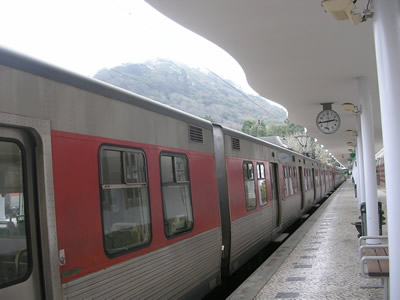
From Rossio Station to Sintra station

Sintra Station.

Trains to Sintra (and vice versa) leave every 15 minutes, a 45 minute trip. The access of trains to the Rossio station is made by a tunnel more than 2600 m long. This tunnel was escavated under the city and is considered one of the most important works of engineering of Portugal in the XIX century.

From Rossio Station Lisbon to Sintra station

Sintra Station

Besides: if you prefer to go by car to visit Sintra, the IC19 superhighway takes you directly from the city and it comes to an end at Sintra . Parking is possible, 10 minutes walk from the center of Sintra.
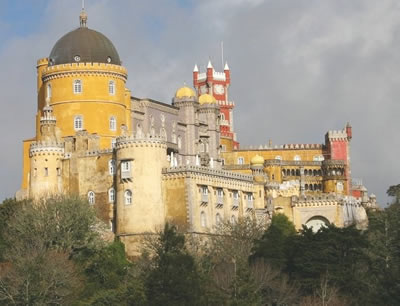
Sintra Palacio da Pena

The Pena National Palace, built by a noble man for his Portuguese wife

A one-day ticket (around 7 Euro) can be bought at Sintra station and will allow you to get on and off at all the main attractions, like f.i. Pena Palace and The Moorish Castle.

Sintra National Pena Palace July 2011. Picture: Maurits Benschop
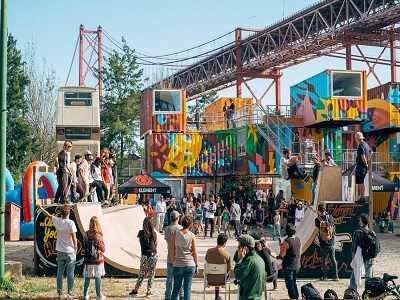
Village Underground Lisbon: creative community & Polly Robbins

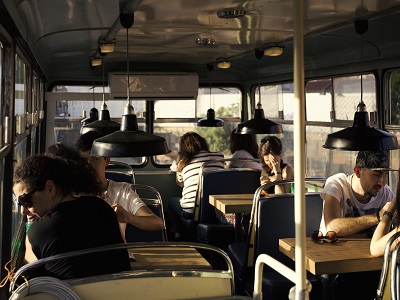
How about a delicious dinner in a dubble-decker retro bus beneath the 25th April Bridge? A great experience, but Village Underground in Lisbon offers much more! It’s a coworking center for creative- and event industries located at the Santo Amaro station in Alcântara, next to the Carris vintage trams & buses Museum.

village-underground-lisbon-1

Village Underground Lisbon in summertime

Lisbon: the hippest place to be

For years, Lisbon was somewhat off the beaten track for young travellers, or millennials seeking a new home. The Portuguese capital crumbled romantically while London, Paris, Barcelona and more recently Berlin enjoyed the cultural status. Yet in the last 10 years the city has seen an explosion in culture, tourism and entrepreneurialism, and is now surpassing its European rivals as the hippest place to be!

village-underground-polly-robbins-november-2016-3

The Village Underground in Lisbon & Polly Robbins, November 2016

Who are you and how have you found yourself at Village Underground?

Polly Robbins: “I come from London. I love London, but the pace of life is crazy and I felt like spending some time in another European capital. Lisbon particularly attracted me because I’m interested in urban cultural development. I studied sociology, looking at how art movements develop in cities, and for the last 3 years I’ve been running a business in London that takes over empty spaces and makes them into venues for culture”.

village-underground-lisbon-dubble-decker-buses-and-containers-3

Village Underground Lisbon

Ex-pats & tourists in Lisbon

Polly Robbins: ‘I heard about Village Underground Lisbon from a contact who knows the London branch. So I contacted Mariana (Director VU), got some funding from the EU Erasmus Young Entrepreneurs scheme, and here I am. At Village Underground I am developing marketing and communications, specifically for the ex-pat and tourists in Lisbon. I’m also developing ways for the co-working community to share their skills and feel more part of a community”.

village-underground-lisbon-live-music

Village Underground Lisbon

So what is Village Underground?

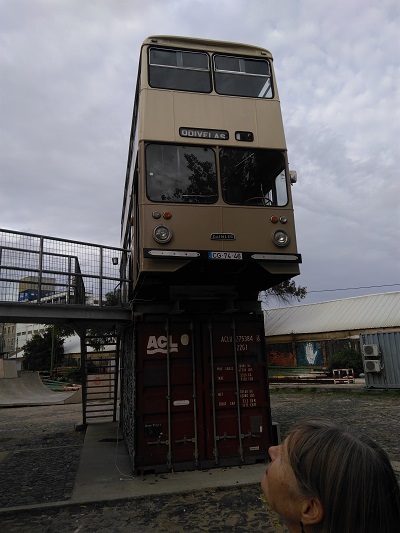
Polly:” It’s a project that began in London in 2009 when a group of friends had a crazy idea to hoist to some decommissioned tube train carriages onto the roof of a building and create a co-working space in Shoreditch. Mariana Duarte Silva, who is the Director of Village Underground Lisbon, was working in London when she came across the space and took a desk to set up her own music agency. She fell in love with it and brought the concept back to Lisbon, where the doors opened in 2012″.

village-underground-lisbon-dubble-decker-bus

Village Underground Lisbon & one of the retro dubble-decker buses

Creative community

Polly: “Village Underground Lisboa sits at the end of the municipal tram yard, beneath the iconic Ponte 25 de Abril. It consists of 14 shipping containers which act as a co-working space for the creative industries. There are about 35 people working here, in web design, graphic design, video making, branding, theatre and music”.

village-underground-lisbon-dubble-decker-bus-december-16-2

Village Underground Lisbon & one of the dubble-decker retro buses, November 2016

Cafe/restaurant & events from January 2017

“There are 2 converted retro buses, one is a café, open to the public every lunchtime and for dinner on Fridays and Saturdays. And in addition, there’s a warehouse space used for events and exhibitions, a recording studio, a large space outside used for events and a skate ramp.

There is a great range of events going on at Village Underground, from parties with electronic and live music, to markets, to exhibitions and performance. Starting January 2017 these will be hosted every Friday and Saturday”.

village-underground-lisbon-dinner-dubble-decker-bus-december-2nd-16

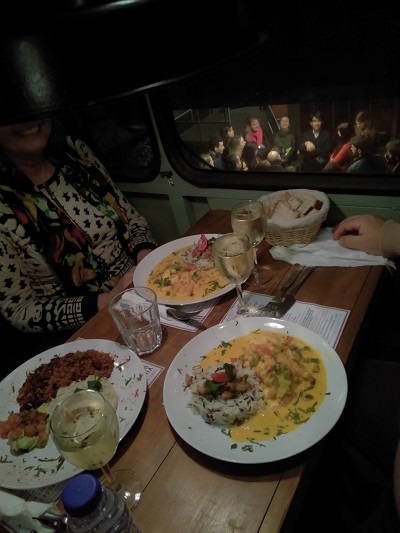
Village Underground Lisbon & delicious dinner in a dubble-decker retro bus 🙂

Tasty food & affordable prices

Our dinner: tapas; Peixe (fish): Moqueca de camarão com arroz selvagem (shrimp Moqueca with wild rice)Chili com carne com basmati de coentros (Cili con carne, basmati rice with coriander): wine , water, sobremesa (dessert). Bill: 77 euro (3 persons). A vegetarian dish is also available.

village-underground-lisbon-dinner-dubble-decker-bus-december-16-view-window

Village Underground Lisbon & a group of visitors

Why should people visit Village Underground?

Polly: “It’s a really interesting space to be in physically, particularly if you like to be surrounded by cool architecture, street art and disused trams and buses! The café serves incredibly tasty food and the team working there is lovely. The people who gravitate towards Village Underground are an amazing bunch – I’ve been warmly welcomed! They come from all walks of life and you don’t have to be chatting too long before you discover that they’re involved in all sorts of weird and wonderful projects”

Village Underground Lisbon delicious lunch January 2017

Village Underground Lisbon & delicious lunch in a dubble-decker retro bus

Muito obrigada! Great food & great service 🙂 🙂

Mafalda Rodrigues, Tania Pines & Mafalda Pais

Village Underground Lisbon delicious lunch January 2017 2

Village Underground Lisbon & delicious lunch in a dubble-decker retro bus

Vegetarian dish, sandwich with salmon, sweet potatoes, 2 glasses of wine, small bottle of water & coffee: 18 euro


Village Underground Lisbon

Both the interior and the terrace have free Wi-Fi. There is free parkingThe only entrance to the Cafeteria is the main gate of the Carris Museum, located at Rua Primeiro de Maio, 103.

Historical area Mouraria Lisbon, fado museum & Amália Rodrigues, queen of fado

No neighborhood in Lisbon is praised more for Fado music than Lisbons historical area Mouraria.

Mouraria Calçada de Santo André balcony with flowers

Mouraria, Calçada de Santo André.

This ‘Bairro‘ (neighborhood) is a maze of little, narrow streets, situated between Graça, Alfama and Costa de Castelo, given it’s name by the first Portugese king, Dom Afonso Henriques (1109 – 1185) , after Lisbon was taken over again by the (Christian) Portugese army from the Moorish overlords. The Moors however kept on living in the city after the conquist and gathered in this area.

Portuguese blues

It is said that the melancholic sounds of the music and singing of the Moorish people was at the base of Fado (meaning fate) music, often described as the Portuguese blues. Its passionate songs overflow with saudade ( yearning), with sorrowful themes like despair, loss, betrayal, jealousy and unrequited love. The little streets of Mouraria are full of typical small grocery stores, old bars (some Fado taverns) and cheap traditional restaurants.

Ginja Cafe in area Mouraria

More history of Fado (and the sad story of the legendary fadista Maria Severa (1820 – 1846) on this website.

Stencilled paste-up of Amalia Rodrigues, Beco dos Cortumes August 2007

Picture: Jef Aerosol. Stencilled paste-up of Amalia Rodrigues, Beco dos Cortumes, Alfama, Lisbon

Amália Rodrigues, Rainha do Fado (‘queen of Fado’) was born near Mouraria on Rua Martim Faz in 1920. She was a genius and worldwide famous Fado singer and lived for many years on Rua de Sao Bento 193. Nowadays her house is a museum, it’s just like she’s still living there…  Casa Amalia Rodrigues ; 30 minutes guided tours from Tuesday – Sunday 10:00 – 13:00 and 14:00-18:00. Metro: Rato.

Amália Rodrigues lived near Mouraria, one of her very famous songs: Ai, Mouraria (Oh Mouraria), da velha Rua da Palma (near the old street ‘Rua da Palma’), onde eu um dia (where one day), deixei presa a minha alma (my soul became a prisoner)…

Amalia Rodrigues tomb Panteao Lisbon

On October 6, 1999, Amália Rodrigues died at the age of 79 in her home in Lisbon.

Portugal’s government promptly declared a period of national mourning. She is now buried at the National Pantheon alongside other Portuguese notables.

Amalia Rodrigues shop Rua Aurea 274

‘Discoteca ‘Amalia’ Rua Aurea 274, a shop specialized in traditional Fado music. Very friendly and professional staff.

For those interested in knowing more about fado music style: the Fado Museum  is located in front of Largo do Chafariz de Dentro (the historic Alfama neighborhood) including a permanent exhibition, a temporary exhibition area, a documentation centre, a store, a small auditorium, a school, and a restaurant/coffee-shop. Saturdays and Sundays, 4h30pm guided tour of the museum featuring the participation of fado singers of different generations.

Open from 10:00 am – 18:00 (closed on Mondays)

Top tourist attraction Lisbon: bronze sculpture famous poet Pessoa & history

The bronze sculpture in Lisbon of Portugal’s famous writer and poet Fernando Pessoa (1888-1935) is extremely popular.

Lisbon cafe A Brasileira tourist attraction statue Fernando Pessoa

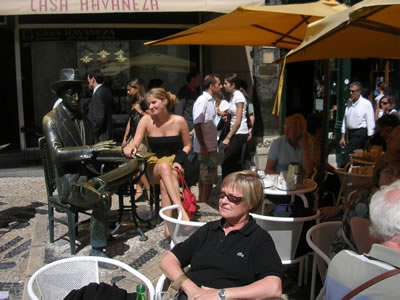
Sculpture of famous poet Fernando Pessoa, kissed by a young girl, almost 80 years after his death!   🙁

Top tourist attraction

Famous cafe ‘A Brasileira’  ‘s terrace in Lisbon (Rua Garrett 120) is a real tourist attraction. Poet Fernando Pessoa once was a regular customer. His table in bronze was created by Lagoa Henriques.

Pessoa statue Rua Garett A Brasileira9

Famous old cafe ‘A Brasileira’  (‘The Brazilian’, opened in 1905) Lisbon, Rua Garrett

Who was poet and writer Fernando Pessoa?

Pessoa was largely unknown in Portugal until after his death in 1935. The man has no idea he’s mobbed by lots of tourists nowadays, all day long!

Lisbon Pessoa statue Rua Garrett & friend Hans

Sculpture poet Fernando Pessoa Lisbon & Dutch admirer Hans

‘The best way to travel is to feel’ Pessoa wrote, ‘so feel everything in every possible way.’ Pessoa was born in Lisbon in 1888.

Apart from his high school years which he spent with his mother and half brothers in South Africa, he lived in Lisbon without a break, without taking public holidays, without traveling abroad. He did so with the help of heteronyms, inventing many lives (and cities) out of his own, spent between the Chiado area, where he lived.

Restaurant Martinho da Arcada table Pessoa famous Portuguese writer

Quality Restaurant Martinho da Arcade, Lisbon.

Restaurant Martinho da Arcade Lisbon & Pessoa’s table

Portugal’s famous poet and writer Pessoa spent a lot of his time in cafes (like Cafe Martinho da Arcada, where he wrote and drank a lot . He died in 1935, aged 47.

Pessoa’s table is still there…

Fernando Pessoa

Fernando Pessoa

Casa (house) Fernando Pessoa, Rua Coelho da Rocha, 16, Campo de Ourique.

Open from Monday – Saturday 10:00-18:00.

Pessoa drawing Travessa do Sequeiro

Drawing Fernando Pessoa, Travessa do Sequiero Lisbon

“Acordar”, poem by Álvaro de Campos, one of Fernando Pessoa’s various ‘heteronyms’ (imaginary characters).

“Acordar da cidade de Lisboa mais tarde do que as outras
Acordar da Rua do Ouro
Acordar do Rossio, as portas dos cafés
Acordar…..
E no meio de tudo a gare, que nunca dorme
Como um coração que tem que pulsar através de vigilia e do sono”

“The waking up of Lisbon, later than other cities
The waking up of Rua do Ouro
The waking up of Rossio Square, at the doors of its cafes
Waking up…..
And in the middle of it all the train station, which never rests
Like a heart that has to beat in both waking and sleeping hours”

Pessoa drawing Rua 1 Dezembro Lisbon

Rua Primeiro de Dezembro, April 2009

Historical red tramcar tour ‘7 hills’ Lisbon & Hop on Hop Off

Although public transport (tram 28) is much cheaper, this historical red tramcar tour allows you to know the most picturesque neighborhoods of Lisbon in a friendly and comfortable way, while listening to the commentary available in several languages or melancholic melody of fado music.

Lisbon red tourist tram 7 hills Praca do Comercio

Historical red tramcar tour &Praça do Comércio Lisbon

Tickets

Red tram tour, leaving from one of the most beautiful squares in the world: Praça do Comércio where you can buy a ticket. From around € 17-20 p.p. Child (4-9) around € 10

Online tickets

You will pass the narrow and steep streets of the city’s traditional quarters. You will see chatting people on doorsteps and feel the village atmosphere of Alfama and Mouraria and reveal a sharp contrast to the elegant, noble buildings of Chiado and Lapa. You will certainly fall in love with Lisbon and sooner or later you will come back……

Lisbon historical Red tram tour driver Paulo Dias starting point Praca do Comercio

Red tram driver Paulo Dias historical red tramcar tour Lisbon

HOP ON HOP OFF

“You can take advantage of the ‘Hop On Hop Off” system. This allows tourists to get off at each stop (20 min.), visit the surrounding area, and then get back on the tram or wait for the next one.

Tickets & prices

The ‘ 7 Colinas‘ (hills) route (about 1 1/2 hour, ) departs every 30 minutes, from 10:00-20:00 (from June-Sept), from 10:20-17:40 (Oct-May).

Lisbon historical red tram tour tourists

Historical red tramcar tour Lisbon

“The ‘Carristur’ company has faithfully restored the interior of the trams dating from the thirthies and fourties, preserving their charm and original character.

Lisbon church Mouraria

Historical red tramcar tour Lisbon

Little church in Mouraria. More about this old neighborhood, home of fado music…..

This ‘ 7 Colinas’ (hills) route goes through the oldest and most traditional districts, giving its passengers a real taste of the city. Mouraria, Alfama, Chiado, Sao Bento and Estrela are just some of the districts that can be seen in the tram.

Lisbon historical red tram tour Alfama near flea market Feira da Ladra

Historical red tramcar tour Lisbon

Alfama. This street is close to the legendary Feira da Ladra (‘thieves market’) and the castle of São Jorge (Castle of Saint George)

Lisbon historical Red tram tour Pessoa statue girl

Historical red tramcar tour Lisbon

Chiado, Rua Garrett. Famous cafe ‘A Brasileira’ with the statue in bronze of the poet Fernando Pessoa, mobbed by lots of tourists, all day long! And of course you will pass the Bica funicular

Lisbon historical Red tram tour Rua de Sao Paulo Rua Boa Vista stairs

Historical red tramcar tour Lisbon

Rua Sao Paulo/Rua da Boa Vista

Lisbon Red tram historical tour tourists see other tourists

As a tourist you will see a lot of other tourists waiting for tram 28

TRAM 28 (eletrico) is very popular . The number of tourist has been increased (2016), which means that tram 28 route is mostly fully packed.

Lisbon Red tram tour sightseeing little streets Pastelaria

Historical red tramcar tour Lisbon

Lisbon & lotteries: Rossio Square & story about jackpot queen Leonor

After buying postcards in Lisbons’ touristical shops or kiosks at Rossio Square, you need stamps (selos) to send them to your friends or family. ‘Very sorry, no stamps’ (‘Desculpa, não selos’).

UPDATE 2016: most shops sell stamps. Update 2021: this shop is closed

Lisbon Rossio square kiosk

Rossio (square Dom Pedro V

This square is a traditional meeting point both for Lisboetas (locals) and visitors.

Lisbon Rossio Portugese man drinking a Ginja

Besides, Rossio near Restauradores:

Portuguese like to drink a ‘Ginjinha’, a liqueur made of berries.

Lisbon Rossio lottery

For stamps friendly Portuguese shopowners will explain you how to walk to a nearby postoffice.

Or they tell you to go to ‘Casa da Sorte’ (a lottery shop), where’s a little postoffice inside, Praça Dom Pedro IV, # 120.

Lisbon Rossio lottery Casa da Sorte

As soon as you’re inside, you forget about the stamps….

Portuguese people love lotteries!

Lisbon shopping stamps Casa da Sorte Rainha Dona Leonora

Queen (rainha) Dona Leonor

In the corner of the lottery shop queen (rainha) Dona Leonor, wife of the 15th century king Dom Manuel I.

She created the ‘Foundação da Misericórdia’ (Foundation for Charity) that is still very active in Portugal today. The original purpose of the Foundation was to build and manage hospitals and homes for the old and needy. Today, the Foundation has spread its wings in obtaining funds and they run all forms of Lotteries in Portugal.

Lisbon lottery

Dom Pedro IV Square, or Rossio (big square), in the evening, one of the most beautiful Squares in Lisbon.

Lisbon Rossio

Historical information Rossio:    http://en.wikipedia.org/wiki/Rossio

Tasty & cheap: restaurant ‘O Cantinho do Custódio’ Lisbon & Garden Cerca da Graça city views

Not trendy or chic, but very tasty and cheap: typical Portuguese food in Mouraria, historic area of Lisbon, close to a new park with wonderful old town city views. Easy to reach from square Praça Martim Moniz (tram 28). Closed on Sundays.

Restaurant ‘O Cantinho do Custódio’ Mouraria Lisbon, owners & daughter Ilda

Away from tourist areas in Lisbon you can find good and cheap restaurants, like restaurant ‘O Cantinho do Custódio’ (Custódio ‘s Corner) in historic area Mouraria: tasty Portuguese food for a very good price: around 5-7 euro pp  😉

Restaurant ‘O Cantinho do Custódio’ Mouraria Lisbon: good and cheap Portuguese food

Our bill: bife da casa 7.00 € (Portuguese fried beef with an egg on top of the meat, rice, or fried potatoes and salad), polvo (octopus): 5.00 €, carafe of house wine 0.50 l (vinho da casa): 1.40 €, bottle of water (agua): 0.85 €, dessert (sobremesa): maçã assada (roasted apple) 1.50  €, 2 coffee: 1.20  €, licor Beirão  (Portuguese liqueur) : 0,75  €

Restaurant ‘O Cantinho do Custódio’ Lisbon: polvo & batata cozida (octopus & potatoes) 5.00 €

Very popular: bitoque (Portuguese steak)

The Portuguese steak, bife, is a slice of fried beef served in a wine-based sauce with fried potatoes, rice, or salad.
Bitoque (toque means touch), comes from the idea that the meat only ‘touches’ the grill twice, meaning that it does not grill for too long before being served, resulting in a rare to medium-rare cut of meat. A fried egg is placed on top of the meat.

Restaurant ‘O Cantinho do Custódio’  area Mouraria Lisbon: tasty and cheap Portuguese food

Restaurant ‘O Cantinho’ do Custódio
Calçada Do Monte 3
Mouraria Lisbon
Tel.: (00351) 218860826, no WiFi

About 10 minutes walk from starting point tram 28 square Martim Moniz

More about  ‘eléctrico 28′. This legendary tram is a tourist attraction in itself. It goes all around town.

Mouraria Lisbon O Cantinho restaurant 2011 Arjen

Restaurant ‘O Cantinho do Custódio’  area Mouraria Lisbon: very tasty and cheap Portuguese food

Eat & drink like a local

Although this restaurant is quite close to the touristy areas of Lisbon, this is a local place that serves typical Portuguese food. You are very welcome, but the owners do not speak English.

Restaurant ‘O Cantinho do Custódio’  area Mouraria Lisbon & roasted apple 1.50 €

Historical area Mouraria & history

Historical area Mouraria exists more than 900 years, together with Alfama Lisbon’s oldest neighborhoods of great historical value. The former Moorish quarter is a muddle of very narrow streets, stairs and small squares, which gives the visitor a glimpse of a forgotten age.

Garden Jardim da Cerca da Graça Lisbon, wonderful views & the Saint George castle

Nearby garden Jardim da Cerca da Graça & wonderful old town city views

The new garden, with an area of ​​1.7 hectares, was inaugurated on 17 June 2015. It is the largest green space for public access to historic districts of Lisbon, the connection between the neighborhoods of Graça and Mouraria, opened to the public.

Garden Jardim da Cerca da Graça Lisbon & wonderful city views

Kiosk & childeren’s playground

According to the Lisbon Municipality, the project implemented on site included the planting of about 180 trees and shrubs. It was closed to the public for centuries.
There are three viewpoints, a picnic park, an orchard, a playground for children and a kiosk with a terrace. They serve soups, sandwiches and homemade cakes. ​

Garden Jardim da Cerca da Graça Lisbon, kiosk & beer: 1 euro 🙂

Jardim da Cerca da Graça
Calçada do Monte 46,
Graça, Lisbon
Opening hours: 10:00 to 22:00 (also on Sundays)
near children’s play ground, Wifi available

Garden Jardim da Cerca da Graça Lisbon & wonderfull city views

More pictures

Bica funicular Lisbon: top tourist spot, June street partys & cool river Tagus cafés

The famous Bica funicular opened on 28 June, 1892, the only stepped street funicular in the city. It climbs the Rua da Bica for 245 metres from the Rua S. Paulo.

Bica funicular Lisbon & partytime in June

Partying in the small street around the famous Bica funicular, near Bairro Alto , one of the best spots in Europe for a night out. In June, the month of the Festas dos Santos Populares (Feast Days of the Popular Saints), the Lisbon nights are filled with lively festivities that take over the city’s historical center.

On the eve of Saint Anthony day, June 12th, Lisbon turns into one big party! … More….

Lisbon Bica funicular3

The most photographed street in Lisbon and Bica funicular Rua Loreto.

Lisbon has three working street funicularsLavra, Gloria and Bica, which allow its citizens and visitors to move to and from its hilly districts more easily. All are operated by Carris, (including timetables and funicular’s history) the Lisbon city transport undertaking.

Lisbon Adamastor December 08

Viewpoint ‘Adamastor’

Five minutes walk from here is a beautiful viewpoint over the River Tagus: ‘Adamastor’, a popular gathering place in Lisbon, which is officially called the  ‘Miradouro de Santa Catarina’ .

Lisbon Cafe Nooibai terrace

Cafe Noobai

Just below the small Adamastor square, you will find the fantastic terraces of cafe/ bar Cafe Noobai , certainly one of the favourite places of many Lisbon locals and visitors of the city!

Alfama Lisbon: old Moorisch quarter, fado restaurants & river viewpoint Portas do Sol

Alfama is certainly the most famous historic and oldest neighborhood in Lisbon, a narrowed maze of streets with many fado restaurants and pictoresque houses.

Alfama near Sao George Castle2

Lunch time in Alfama: Largo Contador Mor

Street close to the Castle of St George

Alfama Lisbon typical restaurant

Historical area Alfama, Lisbon

There are a lot of typical Portuguese restaurants.

The name Alfama originates from the Arabic El Hamma and means something like ‘fountains’ or ‘baths’. The area contains many important historical attractions.

Alfama Lisbon hanging laundry 20

Historical area Alfama, Lisbon

Typical Portuguese is the hanging laundry in the windows, drying in the wind

Lisbon Alfama from viewpoint Portas do Sol

Alfama Lisbon viewpoint (miradouro) Portas do Sol by night

The Belvedere Portas do Sol is a balcony space that all people of Lisbon are proud to have at their disposal. Magnificent view of Lisbon and the typical Alfama district that spans several narrow, winding streets to the river Tagus

Alfama near Rua dos Bacalhoeiros

Historic area Alfama Lisbon Largo do Chafariz do Dentro,

Beautiful azulejos (tiles), close to the Fado Museum (Museu do Fado) ‘a must do’ for those who love Fado music as well as those with an interest in Portuguese culture and history. Near this square you’ll find a lot of small fado restaurants.

Alfama Lisbon street 26

Historical area Alfama, Lisbon

It’s still like a kasbah, this labyrinth of lanes (becos) paved with pebbles, tiny alleys, steps, arches, courtyards and small squares. Houses, shouldering each other, with tiles (azulejos) and wrought iron balconies with lazy cats, birds in cages and sometimes a sleeping dog….more…

Alfama drawing wall sardines music

Historical area Alfama, Lisbon

Sardines and music in LisbonFestas dos Santos Populares (Feast Days of the Popular Saints) in June & Santo Antonio (Saint Anthony)

‘Shoemakers’ street Lisbon: 19th C. Art Nouveau strip club, peep shows & picanha

In the 19th century, Baixa was Lisbon’s commercial heart, with streets named according to their trades. Rua dos Sapateiros means ‘the shoemakers’ street.

Lisbon Rossio Rua dos Sapateiros1 Arco do Bandeiro

The entrance to the Rua dos Sapateiros is spanned by the decorative arch Arco do Bandeiro.

This bears the name of the wealthy sponsor Pires Bandeiro who commissioned it at the end of the 18th C.

Rua dos Sapateiros2 Art Nouveau old Cinema peep shows

Strip Club Rua dos Sapateiros Lisbon

Strip club & Art Nouveau style

Passing through the arched gateway on Rossio you see one of Lisbon’s remaining examples of Art Nouveau: this old movie house, the Animatógrafo , is a strip club nowadays. Lisbon’s earliest cinema hall opened in 1907, by brothers Ernesto and Joaquim Correia Cardoso. It has remained unaltered since then. The beautiful facade is adorned with a highly detailed Art Nouveau style, which consists of Azulejos tiled panels, which depict Edwardian styled females surrounded by fruits and flowers.

Rua dos Sapateiros: cafes, cheap traditional Portuguese restaurants & peep shows2

Rua dos Sapateiros Lisbon

It was not easy to make a picture without snapping visitors going in and out, because this beautiful house is rather popular….. 🙂

Traditional restaurants & picanha meat, ‘melt-in-your mouth’

Rua dos Sapateiros Lisbon: cheap traditional cafes, restaurants & peep shows5 Restaurant Adego Mo

Restaurant Ádega da Mo’, R. dos Sapateiros 199, Lisbon

Restaurant ‘Adega da Mo‘ is  a typical Portuguese restaurant.

Almoçar (lunch): Picanha, (meat from Brazil) is generally considered to be the number one cut, even better than beef fillet. Picanha (pick-ahn-yeh) is much better than a steak, meltin-in-your mouth….: € 7.50

Lisbon Leitaria Camponeza22

Rua dos Sapateiros Lisbon

Another beautiful example of Portuguese Art Nouveau in this street is Leitaria ‘A Camponeza’

Rua dos Sapateiros Lisbon: cheap traditional cafes, restaurants & peep shows street

Rua dos Sapateiros, Lisbon