Café ‘Leitaria A Camponeza’ Lisbon, once a milkshop & Portuguese ‘Art Nouveau’ style

If you look for a nice and quiet café after walking around in the Rossio area in Lisbon, this 100 years old cafe is really worth it to sit down and admire the place !

Lisbon cafe Leitaria Camponeza2

Cafe ” Leitaria A Camponeza”, Lisbon

This is an old-fashioned Leitaria (milkshop), specializing in milk products and pastries, whose blue-tiled walls display bucolic scenes.

Mostly Purtuguese people are drinking a bica (strong coffee) or a tea (chá) while reading a newspaper.

Lisbon Leitaria Camponeza4

Cafe ” Leitaria A Camponeza”, Lisbon

This house is for over 100 years in the same family: Ana Claudia Diogo (r) and her niece Filipa Indias.

Lisbon cafe Leitaria Camponeza7

Cafe ” Leitaria A Camponeza”, Lisbon

Ana Diogo’s grand grand father, José Domingos Diogo, built this place (pictures of the family are hanging on the wall), from origin a milkshop, in Portuguese ‘Art Nouveau’ style and beautiful tiles (azulejos). The café was recently renovated, but with care….

Lisbon cafe Leitaria Camponeza10

Cafe ” Leitaria A Camponeza”, Lisbon

Chá (tea) in a pot (in style) 1,20 euro. The coffee, cakes, and sandwiches are all good.

Lisbon cafe Leitaria Camponeza8

Cafe ” Leitaria A Camponeza”

Open from 07:45 – 19:00, closed on Sundays

Lisbon cafe Leitaria Camponeza15

Cafe Leitaria ‘A Camponeza’ , Rua dos Sapateiros, 155/157, Lisbon

Portuguese pavement, lovely wave design, high heals & Theatre Dona Maria II Lisbon

Portuguese pavement workers are real artists! In Lisbon there’s always a lot of work to do, like in Rua da Rosa in Bairro Alto, one of the oldest districts.

Lisbon pavement workers Bairro Alto

Lisbon, area Bairro Alto

Upon a well compacted trench of argillaceous materials, craftsmen lay a bedding of gravel, which will accommodate the stones, acting as a cement.

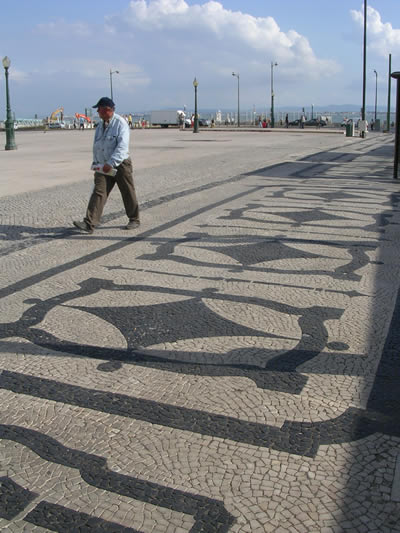
Pavement Lisbon wave design Rossio

Lovely wave design “the wide sea”, Lisbon’s Rossio Square, the popular name of the Pedro IV Square (Praça de Dom Pedro IV), the ‘heart’ of Lisbon

Teatro Nacional Dona Maria II.

You can discover the theater (or take the time to enjoy a good show). From Monday to Friday there are guided tours, in several languages.

The pavement mostly is laid out in a repetitive pattern, or recreates symbols that are evocative of Portugal’s nautical past.

Besides: the neoclassical Dona Maria II Theatre was built in 1842 on the site of the former Inquisition Palace where processions, auto-da-fés (execution by burning) and public executions took place from 1531 to 1777.

Lisbon pavement Rua Aurea

Beautiful pavement in Rua Áurea, a shopping street in Baixa

Slippery cobbles & high heels

Besides: despite of the artistic appeal, this pavement is not really safe. The uneven surface makes it difficult to navigate. When the cobbles are wet, they are rather slippery. A reason for ladies not wearing high heels…..don’t forget your sandals!

Lisbon pavement Praca do Comercio

Pavement Praço do Comércio, 2008

a spectacular example of Portuguese calçada, made by hand.

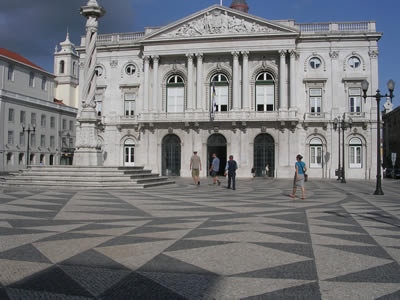
Lisbon Pavement Camara Municipal

Pavement Praça do Municipao with Lisbon’s beautiful City Hall (Câmara Municipal). Visitors can admire the interior on Sunday mornings for free.

Future for pavement workers the future is unsure. Once an activity performed by hundreds of craftsmen in Portuguese cities and villages, traditional paving is increasingly becoming restricted to conservation works or important architectural projects. Less abundant materials, dwindling numbers of craftsmen and criticism to its widespread use are forcing municipalities to consider other alternatives.

Lisbon Walker: guided walks through historical Lisbon

Lisbon has steadily built up an image of one of the world’s most interesting cities to visit. Its stunning location and historic significance is generously complemented by remarkable aesthetics, making it stand out as one of the few capital cities still human in pace and in scale.

17thcenturyportal.jpg

To discover Lisbon in the company of friendly and knowledgeable tour guides is the whole point of Lisbon Walker, overtaking the limitations of guidebooks to unveil the real personality of this unique location. All walking tours are in English.

s_joao-praca-22.jpg

If you want to join one of the tour guides for a walk through Lisbon, just choose one of the historical tours on the Lisbon Walker Website and all you need to do is show up at the meeting point near Praça do Comércio, according to the timetable of the walks. Regular walking tour ticket (2008) – €15.00 per person/tour. Under 26, over 65, holders of Lisboa Card or valid tickets from TAP, CP or Sightseeing tours: €10.00 per person/tour. Children under 12 free tour. Each walk takes between 2 and 3 hours.

Lisbon Walker Fish Market

Fish Market

Lisbon Walker Bairro Alto

Bairro Alto

Lisbon walker Carmo Square

Square (Praça) do Carmo

Lisbon Walker Alfama

Alfama


Famous Cafe ‘A Brasileira’: wonderful Art Deco style & poet Pessoa’s table

Elegant shopping street Rua Garrett,  lIsbon, that leads from the Baixa to Chiado, is named after the author and poet Joao Almeida Garrett (1799-1854). The area is also an important cultural area, with several museums and theatres.

winkelen Rua Garrett2
Rua Garett, June 2008.

On the background cafe ‘A Brasileira’ s terrace. You will see young locals here just socialising or window shopping.

Lisbon shopping Rua Garrett building

Rua Garrett, Lisbon

The most famous street of Lisbon, that mixes traditional chic and modern commercial shops, is also beloved by tourists.

Pessoa statue Cafe A Brasileira tourists

Cafe ‘A Brasileira’ (Rua Garrett 120) is famous for having had the enigmatic poet Fernando Pessoa  (1888-1935) among his customers.

Pessoa still has his table in bronze on the terrace (the work of sculptor Lagoa Henriques).

Portugal’s famous writer has no idea he’s mobbed by lots of tourists, all day long!

The downstairs seating area is a favourite with locals for a set lunch of traditional Portuguese specialties. The cafe once was the setting for tertulías literárias (lively discussion groups) in which debate would often culminate in chair throwing, cup smashing and brawls.

Lisbon shopping: Rua Garett cafe a Brasileira outside

‘A Brasileira’ (‘The Brazilian woman’), opened in 1905 as a shop selling genuine Brazilian coffee.

It was the first shop to sell the ‘bica’, a small cup of strong coffee, similar to espresso.

Lisbon shopping Rua Garrett cafe A Brasileira inside

The interior of ‘A Brasileira’ is grandiose: decorated in Art Deco style, with a green-and-gold entrance, mirrored walls, brass fittings, and a long oak bar.

However: bad service and inattentive staff  for tourists. It’s a very popular tourist destination, and prices are high.

Restaurant ‘A Travessa’, one of Lisbon’s best & unique location

We had heard great things about ‘A Travessa’, a trendy restaurant located in a former convent in Bairro da Madragoa, and one of Lisbon’s best: from food, service to location.

Restaurante A Travessa inside

Restaurant ‘A Travessa’ Lisbon

The building used to be a 17th century convent. Set in the very peaceful quarter in Santo (Lapa) this is one of the most atmospheric restaurants in Lisbon. There are at least three dining areas; the main room, a small side room and a terrace in the old courtyard. In the bar right next to the restaurant you can have an appetizer while waiting for your table. In winter, you can dine inside by the fireplace, and in summertime ‘al fresco’ in the wide courtyard.

Restaurant A Travessa dining outside

Restaurant ‘A Travessa’ Lisbon

The menu is Portuguese-Belgian, but international as well. Before you order they do provide you with some original hors d’oeuvres. The wine list includes many of Portugal’s best, including an extensive selection of Douro reds. The place is stunning, the people are really nice and the food is excellent!

There’s no parking area – so don’t go driving, instead use a taxi.

A Travessa (website including the history of the Convent and a virtual tour)
Travessa do Convento das Bernardas, 12
Bairro da Madragoa
Santo
1200-638 Lisbon
Tel: (+351) 21 390 20 34 / 21 394 08 00

Prices: more expensive than average.  Open on 24, 25 & 31 December and 1st January.

Viviane Durieu owner A Travessa restaurant Lisbon

The creator of restaurant ‘A Travessa’ in Lisbon is Viviane Durieu (Belgian origine), read her story and Viviane’s favorite places in Lisbon

Viviane Durieu, creator of ‘A Travessa’ Lisbon, famous restaurant & 17th-century convent

Viviane Durieu is creator of ‘A Travessa’, one of Lisbons best restaurants, set in a 17th-century convent, with a picturesque courty yard.
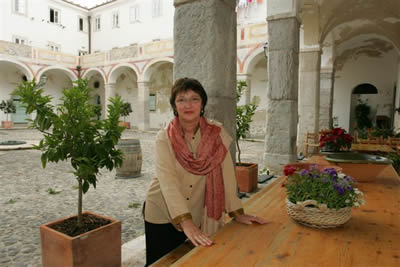
Lisbon people Viivane Durieu 3

“When I arrived in Lisbon in December 1969, two days before Christmas, I thought the climate and the light were fantastic. Especially because I had arrived from Belgium where it’s cloudy for nine months of the year and we only get a few months of blue sky. I remember being surprised to see the leaves still on the trees at that time of year.

I fell in love with the city, and still I’m fascinated by the humanism of the Portuguese and the beautiful light.
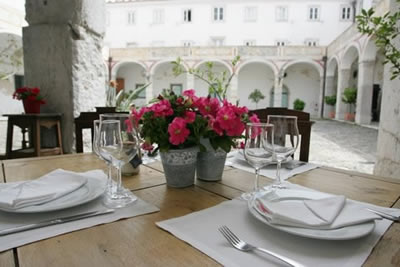
Viviane Durieu restaurant

My background is in photography, I worked in this field until we opened restaurant ‘A Travessa’, which only started as a bit of a joke between me, my husband and a friend.

We opened a small restaurant with good products: coffee that you couldn’t find in Portugal at that time, good bread and good wine, just round the corner from the current ‘A Travessa’, next to the Portuguese Parliament building and surrounded by embassies. Because we were French speakers we got lots of clients from the Belgian and French embassies. It was a hit. We just developed from there and it’s been 30 years this year since we opened. Time flies…..!”

‘A Travessa’ , Travessa do Convento das Bernardas, 12 Bairro da Madragoa – Santo, more details about the restaurant and the menu

“I live in the historic area near the Sao Jorge Castle (Castelo de São Jorge), a delight for residents, with limited car access. The narrow streets of uneven cobbles make life in the centre of the city like living in a village”.

Lisbon entrance Castelo Sao Jorge

Castelo Sao Jorge, entrance

“When I arrived in Lisbon, I use to go to Sintra a lot. As it’s colder there, I felt closer to Belgium and I dreamt about having a house there. World Heritage Site, this historic town lies 40 km from Lisbon, a must for any visitor!”

Sintra Palacio Nacional da Pena

Sintra: National Palace da Pena, now a museum. The very old Palace stands on the top of a hill above the town of Sintra. On a clear day it can easily seen from Lisbon.

“In Lisbon, I like to shop in the Baixa and Chiado areas. I don’t like shopping centers, I prefer traditional shops, it’s much nicer to walk around the town”.
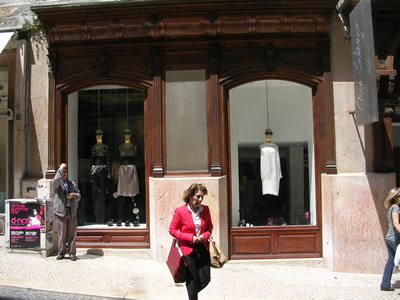
Lisbon shopping Rua do Carmo Ana Salazar

Lisbon, Rua do Carmo, Baixa

“i like going to Belém. The Jeronimus Monastery and the famous classic Belém custard tarts (Pasteis de Belém) , always warm, are real musts! And I like the shows at Centro Cultural de Belém, which has got the best concert hall in Lisbon.”
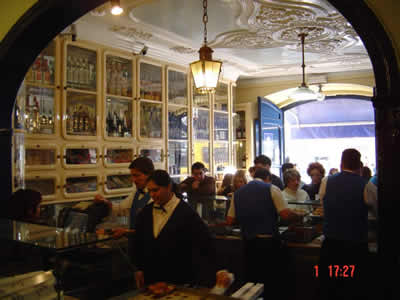
Belem Pasteis de Nata

Antiga Confeitaria, since 1837. The recepe of Lisbon’s most celebrated custard tarts is still a well-kept secret…open 7 days a week.

Lisbon Belem Pasteis de Belem
History: at the beginning of the Nineteenth Century, in Belém, next to the Mosteiro dos Jerónimos (the Heironymite Monastery) there was a sugar cane refinery linked to a small general store. As a result of the liberal revolution of 1820, all convents and monasteries in Portugal were shut down in 1834, the clergy and labourers expelled.

In an attempt at survival, someone from the monastery offered sweet pastries for sale in the shop; pastries that rapidly became known as ‘Pasteis de Belém’.

Graças a Maria Ventura

Historic Alfama Lisbon: the Pantheon, marvelous river views & the remains of Amalia Rodrigues

You can find the Pantheon (Panteão Nacional) on Campo de Santa Clara, near Lisbons’ most famous flea market ‘Feira da Ladra’ (Thieves market)

lissabon-12-17-december-2007-001.jpg

The Pantheon is opened daily, from 09:00 – 13:00 and 15:00-19:00, a ticket cost 2 euro. Address:  Campo de Santa Clara Lisbon.

It is possible to walk around the inside of the dome, you can climb the 169 stairs (I did it, pfffffff!) or use the elevator. From the exterior of the dome the view on the Alfama area and on to the Tagus river is marvelous!

Pantheon view 25 april bridge

View on the historic Alfama area and the Tagus river

History: the Church of Santa Engrácia (Igreja de Santa Engrácia) is a 17th century monument. In the 20th century the church has been converted into the National Pantheon (Panteão Nacional) in which important Portuguese personalities are buried, like Amalia Rodrigues, the famous fado singer.

Alfama Pantheon Amalia Rodrigues

Amalia Rodrigues

Its construction took 284 years and gave origin to the Portugese expression “Santa Engrácia works“, a Portuguese synonym for long unfinished works…..

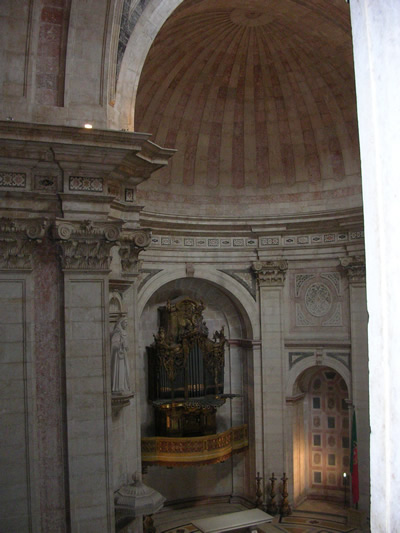
Building work proceeded from 1682 through 1712. Eventually a dome was added, whereupon the church was reinaugurated in 1966. The magnificent 18th-century baroque organ was brought from the Lisbon Cathedral.

Alfama Pantheon organ

The magnificent 18th-century baroque organ

In 1966, during the government of the dictator Antonio de Oliveira Salazar, the Church of Santa Engrácia was turned into a National Pantheon. There are cenotaphs to f.i. Luís de Camões (famous Portugese poet), Pedro Alvares Cabral (Portuguese explorer), Vasco da Gama (commander of the first ships to sail directly from Europe to India) and Prince Henri The Navigator, an important figure in the early days of the Portugese Empire.

Alfama Pantheao Vasco da Gama

Vasco da Gama, his remains are elsewhere….

Bairro Alto Lisbon at daytime: trendy shops, art galleries & fashion queen Fatima Lopes

Lisbon Bairro Alto (high neighborhood) or just Bairro, in the afternoon.

Bairro Alto by day beautiful flowers

During the day Bairro Alto is very quiet.

Elder people with coloured plastic bags are coming back from the market, having a chat with eachother while they slowly climb the steepy streets. The atmosphere is very relaxed. In the shops and in the cafes people take their time to make a friendly neighbourly talk.

Bairro Alto by day

The area has traditionally been Lisbon’s bohemien haunt of artists and writers.

All the major Portuguese newspapers had their offices in Bairro Alto. This picturesque heart of Lisbon’s youth culture, nightlife, shopping and entertainment district, is one of the oldest districts of Lisbon dating from the 16th century.

Bairro Alto Rua da Rosa by day

(Rua da Rosa).

Since the 1990s, Bairro Alto went through major changes. Lisbon’s city council made extensive repairs, and dozens of new restaurants and fado singing clubs animated the area. Trendy shops were opened. Many young people moved into the area. Cars were banned (except for residents and emergency vehicles).

Bairro Alto by day trendy shop

Agência 117, Rua do Norte 117, ‘skunk funk’ fashion.

Nowadays, in Bairro Alto Lisbon’s punk, gay, heavy metal music, goth, hiphop and reggae scenes all have the Bairro as their home, due to the number of clubs and bars dedicated to each of them.

BairroAlto at by day graffiti

During daytime, the Bairro is a traditional district where older people shop for groceries, and the younger generations visit art galleries like Zé dos BoisRua da Barroca 59, bookshops like Ler Devagar (litt. read slowly, nowadays this wonderful shop is situated in LX factory), arty gift shops like Hold Me, Rua do Norte 33, offering a collection of bags and luggage.

Bairro Alto by day shop Fatima Lopez

Local fashion queen Fatima Lopes’ shop , Rua da Atalaia 36.

Grandma Duck

Beautiful clothes, but according to me the window mannequins look like grandma Duck injected with lots of Botox shots…. 😉 😉

Bairro Alto by day graffiti

Despite the police presence, illegal drugs are sold in the streets. Bairro Alto struggles with a problem of graffiti, destroying historical buildings . More……Bairro Alto by night

Breathtaking views: Lisbon, city with 7 hills (colinas)

Lisbon is one of the most beautiful cities in Europe! The ‘cidade das sete colinas’ (city of the seven hills) was originally built over seven hills on the margins of River Tagus. There’s a lot of places with marvellous views!

View from the Castelo Saint George (Castelo de São Jorge)

View from Castelo Sao Jorge Saint George

View on 25th of April Bridge (Ponte 25 de Abril), connecting the city of Lisbon to the municipality of Almada on the left bank of the Tagus River

25 April Bridge Lisbon

View on the Baixa. Terreiro do Paço (or Praça do Comércio) near de river refers to the fact that the royal palace (Paço) was destroyed in the 1755 earthquake. The statue is King José I, who oversaw the rebuilding of Lisbon.

Lisbon viewTerreiro do Paco

One of Lisbon famous funiculars (electrico), the Elevador da Bica or de Santa Justa, opened on June 28, 1892. The only stepped street funicular in the city

Lisbon tram in Bica

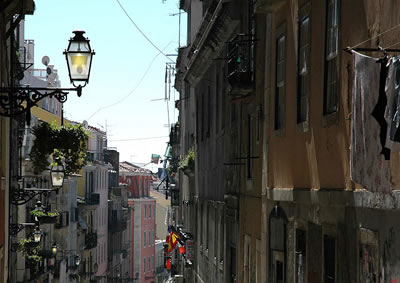
General view on the Alfama, the oldest district of Lisbon

Lisbon general view on the Alfama

View on Praca da Figueira (Square of the Fig Tree), a beautiful large square in Lisbon’s city center, a part of the Baixa area reurbanised after the 1755 earthquake.

Lisbon overview Praca da Figueira

Praca da Figueira Lisbon

Looking for a place to stay a few days in Lisbon? My 3 bedroom apartment with lovely patio in Mouraria is close to this square

View on Largo do Rato and the Tagus River from the terrace of Mae de Agua (“Aqueduct of Free Waters”), a historic aqueduct, one of the most remarkable examples of 18th-century Portuguese engineering.

Lisbon view on the Tagus River

Traditional Fado Vadio Lisbon: taverna ‘Tasca do Jaime’ & black shawl of mourning

UPDATE 2015

Enjoy the real fado while munching on freshly-fried cod pastries in the late afternoon in Tasca do Jaime, one of the most intriguing of Lisbon’s ‘tavernas’. Traditionally, the Fado houses are popular and a meeting spot for families and friends. Close to Lisbon’s legendary flea market ‘Feira da Ladra’

tasca do jaime 2

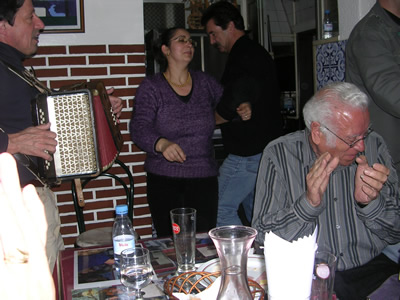
‘Tasca do Jaime’ taverna Lisbon: real fado music

You won’t always find the best fadistas, but don’t let that scare you off. This is real traditional fado, out of the tourist circle, where the fado singers can enter spontaneously and improvise.

tasca do jaime 1

‘Tasca do Jaime’ taverna Lisbon, Saturday afternoon

As soon as somebody gets up to sing the audience stops talking and all the attention is on the singer. The Portuguese have a lot of respect for the performers and it is of utmost importance that the singers can concentrate and express their emotions in their singing. When the song is about to finish the audience starts applauding and cheering.

tasca do jaime 3

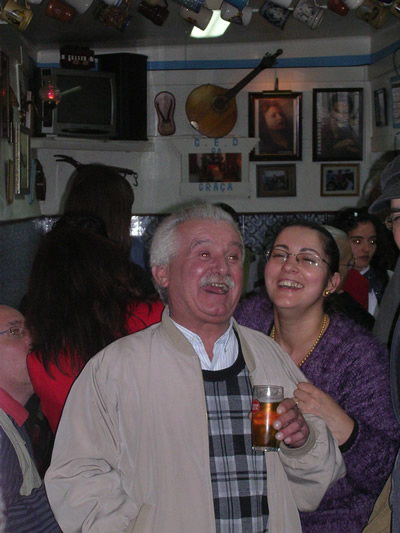
‘Tasca do Jaime’ taverna Lisbon

Fado Vadio on Saturdays, Sundays and public Holidays from 16:00 to 20:00, Rua da Graça 91, Lisbon.

tasca do jaime 4

‘Tasca do Jaime’ taverna Lisbon

Fadistas, as fado singers are known, often wear a black shawl of mourning, as one of Maria Severa did after her heartbreak. Her story epitomizes fado’s connection with saudade, “a feeling of longing or nostalgia”.