Park Eduard VII Lisbon, exotic Greenhouse & tasty lunch Central Parque Kiosk

Park Eduard VII in Lisbon is popular: people from all over the world make amazing photos from the top of the park. It is also really worth it to visit the Greenhouse at the end of the park and the kiosk with terrace where you can enjoy your coffee or lunch. Great place for families with children!
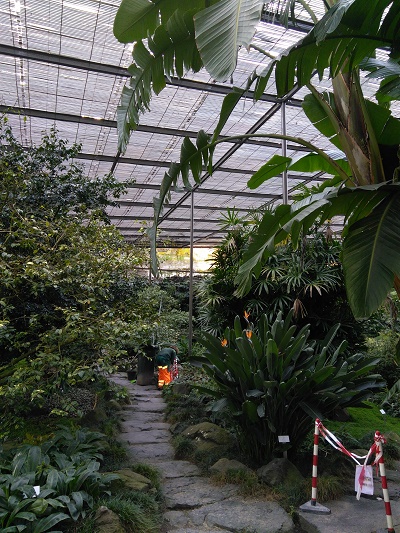
greenhouse-lisbon-estufa-fria-nov-2016-1

Lisbon Greenhouse & Estufa Fria (litt. the Cold House), November 2016

Wonderful atmosphere

The Estufa Fria de Lisboa is an eight hectare greenhouse that was erected in 1933 by architect Raul Carapinha, located in Eduardo VII Park, one of the most important parks that exist in the city. It is one of the most visited sites, by both students and tourists. MAP
 –
greenhouse-lisbon-estufa-fria-nov-2016-5
Lisbon Greenhouse & Estufa Fria (litt. the Cold House), November 2016
The Greenhouse, initially thought out as a place to simply shelter various types of plants, it has become one of the most pleasant green spaces in Lisbon, where you can spend a few enjoyable hours between lakes, waterfalls, brooks, statues and hundreds of different plant specimens from all over the world. A place that gives its visitors a sense of tranquility and well being.

greenhouse-lisbon-estufa-fria-nov-2016-2

Lisbon Greenhouse & Estufa Fria, November 2016

Lisbon Greenhouse & three different areas

This Greenhouse is managed by the Lisbon City Council and is divided into three different areas: (Estufa Fria), litt. the cold house, without heating system; Estufa Quente (the Hot House), with glass dome, and the smaller Estufa Doce, (Sweet House), where cactusses are grown.
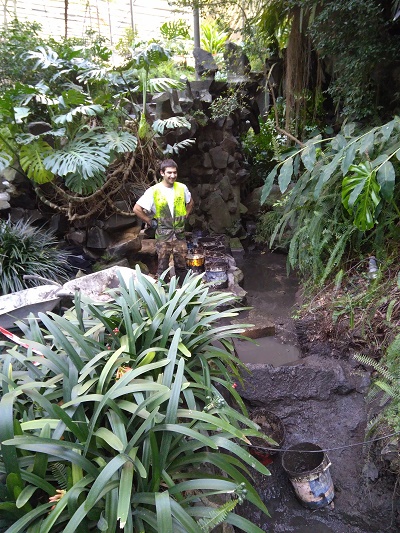
greenhouse-lisbon-estufa-fria-nov-2016-4

Lisbon Greenhouse & Estufa Fria (the Cold House), November 2016

The Greenhouse’s history

The Estufa Fria started being planted in 1910, as a part of the urban plan of the Park Eduaro VII. In 1975 the ‘Hothouse’ and the ‘Sweet House’ were open to the public. These new exhibitions had tropical and equatorial plants on permanent display.

greenhouse-lisbon-estufa-fria-nov-2016-3

Wonderful! Lisbon Greenhouse & Estufa Fria (the Cold House), November 2016

Tickets

Adults: € 3,10, children and teenagers (6/18): € 2,33, students, pensioners: € 1,55. More information…. WEBSITE  Estufa Fria (source)  Facebook

Location: Estufa Fria de Lisboa, Parque Eduardo VII Lisbon

Open: in summertime from 10:00-19:00, wintertime 10:00-17:00. More….

Small lake near the Greenhouse in Park Eduard VII Lisbon & friend Margarethe de Vrieze

Lovely lake with ducks and geese 

Walking out of the Estufa Fria Greenhouse there’s a lake with ducks and geese and a kiosk with a terrace where you can enjoy your coffee or lunch. A lovely and quiet place, also for kids.

Lunch at Central Parque Quiosque, near the Greenhouse, Park Eduard VII Lisbon september 2017

Central Parque Quiosque & tasty lunch 

This is not the first time we went here for lunch, because my friends Alexandra Tops and Margarethe de Vrieze recommended this lovely place in the park where you can order good food for affordable prices.

Lunch at Central Parque Quiosque, near the Greenhouse, Park Eduard VII Lisbon

Ideal place for families with children (they sell pizzas and icecream 🙂 )

Great place under the umbrellas for a drink while the kids play. The kiosk is located next to the Children’s Park.

Our lunch: amondegas de atum (tuna fish, feta cheese) 8 €; salad with mozzarela e tomates 8 €; tosta e frango (toasted bread with chicken) 5.50 € ; glass of white wine 3.50 €; bottle of water 1.20 €.

Very nice staff & relaxed atmosphere! Jessica Tribolet, Francisco Varela and Santos

Central Parque Quiosque , Park Eduard VII Lisbon
Open: every day from 10:00 – 20:00
Wifi available. Facebook

The wonderful building Pavilhão Carlos Lopes is also located in this park.

The building reopened in February 2017, after extensive remodeling work and is now a large, pleasant space with lovely azulejos tile work on its interior and exterior walls.

Famous Portuguese long-distance runner Carlos Lopes

The pavilion is a venue for temporary exhibitions, while a small permanent exhibition on Carlos Lopes displays the great runner’s trophies and equipment, including the shoes he wore during the Los Angeles Olympic marathon in 1984.

Hours: Daily: 10am-6pm. Map
Admission: Free. Read more
: Portugal Visitor 

How to reach Park Eduardo VII: Metro – Parque or Marquês de Pombal Station 

Historic square ‘Largo do Carmo’ Lisbon & April 25 bloodless military coup

Wonderful Largo do Carmo  is one of my favorite squares in Lisbon!  Beautiful trees, historical buildings, fascinating church ruins, the extraordinary Santa Justa elevator and amazing city views!

Largo do Carmo Lisbon, September 2017

This picturesque square is very popular, well known for the terraces, in addition to being the scene of several shootings, both (science fiction) films or documentaries and commercials. Music and traditional dance are performed here during the summer.

Lisbon Largo do Carmo1

Largo do Carmo Lisbon

Springtime 2014

Lisbon square Largo do Carmo kiosk 2

Largo do Carmo Lisbon

A unique fountain stands under trees right in the middle of the square. The Chafariz (fountain) do Carmo was built here in 1796.

Largo do Carmo wikipedia jacarandas

Largo do Carmo and blossoming jacarandas.

Originally from South America, these beautiful trees of the Bignoniaceae family arrived in Lisbon in the mid-17th century and ever since, between May and June when they’re in flower, they have lovely bunches of lilac-toned petals.

Largo do Carmo Military Police Station

Largo do Carmo Lisbon

Portugal’s history & Carnation Revolution

The headquarters of Carmo (Quartel do Carmo) is a very important building for Portugal’s history. Marcelo Caetano (former dictator António de Oliveira Salazar’s replacer) found refuge in the main Lisbon military police station at the time of the revolution.

On April 25, 1974, the day of  the Carnation Revolution, this building was surrounded by the MFA (Portuguese Armed Forces), which pressured Marcelo Caetano to cede power to general Spínola. It was here where the Estado Novo (New Regime) officially came to an end after almost 50 years. More..

25-abril Carnation Revolution 1974 Lisbon

Largo do Carmo Lisbon April 25 1974

1974: The Carnation Revolution (Revolução dos Cravos) &  Eurovision Song Contest

The Carnation Revolution was a largely bloodless coup. Remarkable: there were two secret signals in the military coup: first the airing of the song “E depois do adeus” (“And after the farewell”) by Paulo de Carvalho, Portugal’s entry in the 6th of April 1974 Eurovision Song Contest, which alerted the rebel captains and soldiers to begin the coup.

Largo do Carmo Lisbon & entrance Carmen Convent

Next, on April 25, 1974 at 12:15 am, the national radio broadcast Grândola, Vila Morena, a song by Zeca Afonso, a progressive folk singer forbidden on Portuguese radio at the time. This was the signal that the MFA gave to take over strategic points of power in the country and “announced” that the revolution had started.

More details, videos and songs on Joana Morais’ blogspot

Here you can also find an entrance to the famous Archeological Museum, the gothic ruins of the 14th century Igreja (church) Convento do Carmo).
 –
Lisbon Largo do Carmo church museum Santa Justa2
Ruins of the Convento do Carmo & horrible earthquake in 1755
Open from Monday- Saturday 10h – 18h, cheap entrance. The construction of this monument started in 1389 by order of Nuno Álvares Pereira. The church was destroyed the first of November of 1755 by the horrible and well known earthquake. A lot of people died. More information..
 –
Lisbon Largo do Carmo church museum Santa Justa3
Largo do Carmo  Lisbon: amazing view over Lisbon
The famous tourist attraction ‘Santa Justa elevator’ (Elevador de Santa Justa video), Rua do Santa Gusta, built around 1900 to connect the Baixa and Chiado districts (around 32 m high), can bring you to the Carmo Square.  
 –
Beautiful city view of Lisbon : Santa Justa Lift and Carmo Convent
From the roof terrace of Pollux, a huge warehouse, Rua dos Fanqueiros 276. There’s a pleasant roof terrace & bar/cafe : LESS

History Castle of Saint George Lisbon, knight Martim Moniz & breathtaking views

For the most breathtaking views of the Tagus and Lisbon, walk the esplanades and climb the ramparts of the old Castelo de São Jorge (Castle of Saint George), located on the highest of the seven hills of the historic centre of the city. It is one of the main historical and tourist sites.

Lisbon-castle-entrance

Castle of Saint George

Singer inside the walls of the Castle (video)

Castelo do Sao Jorge entrance

Entrance Castle of Saint George Lisbon

Although the first fortifications on the Lisbon hilltop are known to date only from the 2nd century BC, archaeological research has shown that human occupation exists there at least since the 6th century BC, originally from autochthonous Celtic and Iberian tribes (with probable Phoenician, Greek and Carthaginian influences), afterwards Roman, Suevi, Visigothic and Moorish.

Lisbon-castle-upon-the-hill

Castle of Saint George

In the context of the Christian Reconquista the castle and the city of Lisbon were retaken from the Moors by King Afonso Henriques with the help of Northern European crusaders taking part on the Second Crusade. The Siege of Lisbon, which took place in 1147, was the only success of that Crusade.

Knight Martim Moniz

According to a famous legend, the knight Martim Moniz, noting that one of the doors to the castle was opened, prevented the door from closing again with his own body, sacrificing his life but allowing the Christians to enter the castle.

Lisbon-Castle-Statue_King_Afonso_Henriques_Portugal

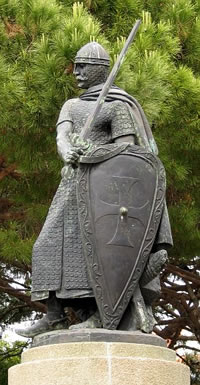
In the square stands a heroic statue — sword in one hand, shield in the other — of the first king, Afonso Henríques

Lisbon Castle of St George tower 1

Picture: Martijn Kramers

Many of the existing walls were erected during the centuries of Moorish domination. The Moors held power until 1147, the year Afonso Henríques chased them out and extended his kingdom south.

Even before Lisbon became the capital of the newly emerging nation, the site was used as a royal palace.

Lisbon: view from Castelo Sao Jorge

Wonderful views!

The castle overlooks the historic area Alfama, the mountains of Monsanto and Sintra, Ponte do 25 de Abril (25 April Bridge), Praça do Comércio, and the tile roofs of the Portuguese capital, Lisbon.

Lisbon seen from the Castle of Jao Jorge April 25 Bridge

Castle of Saint George (Castelo de São Jorge)

Address: Rua da Costa do Castelo
Bus: 37 Tram: 12 or 28
Website: www.castelosaojorge.egeac.pt

Prices: check the website, free for children under 10

Lisbon-castle-overlookiing-the-tagus from the Castelo

Lisbon’s unique Lavra funicular, steep slope & statue dr. Sousa Martins

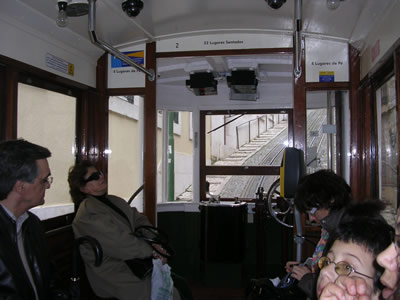
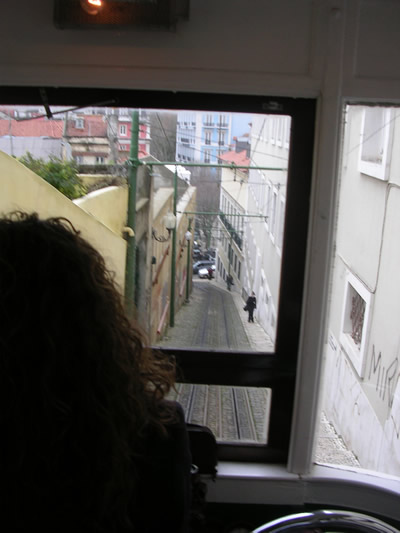
The Lavra funicular was the first street funicular in the world. It opened on 19 April 1884 and carried 3000 people, free of charge, on that day alone! Originally water-powered, it was converted to electricity in 1915.

Lisbon funicular Lavra1 Rua de Sao Jose

YouTube Lavra funicular Lisbon

It runs from the Rua de São José (near Largo da Anunciada) to Travessa do Forno do Torel. To reach the bottom of the funicular, turn right off the Avenida da Liberdade, or, from Rossio Square, it’s a 10 minute-walk through Rua das Portas de Santo Antão.

Lisbon Lavra funicular Rua de São José6

Waiting for the driver……

Lisbon has three working street funiculars: Lavra, Gloria and Bica, which allow its citizens and visitors to move to and from its hilly districts more easily. All are operated by Carris, (including timetables and funicular’s history) the Lisbon city transport undertaking.

Lisbon Lavra funicular Travessa do Forno do Torel

For me, it is still a miracle!

When you turn left off the funicular, after passing Rua do Instituto Bacteriológico, there’s a lovely park, Campo dos Mártires da Pátria, located on one of the 7 hills of Lisbon, the view from here is really wonderful!

Monument dr Martin Sousa

Here you will be surprised by the spontaneous religious fervour of Portuguese people who have honoured the statue of doctor Sousa Martins in front of the Faculty of Medicine. Yet since the memorial was erected in 1904, it has become the focal point for a religious devotion. People who come here believe that by praying to him and asking for his intervention, they will be cured. More….

Lisbon Lavra funicular driver

Lavra funicular hours of operation: 07:00-22:45, every day except Sunday, when the opening time is 09:00. One way ticket: cheap.

The ‘miraculous’ cures of Dr. Sousa Martins & Memorial Statue Lisbon

Dr. José Tomás de Sousa Martins (1843-1897) was a doctor and pharmacist renowned for his work amongst the poor in Lisbon. After his death, a secular cult has arisen around him in which he is thanked for ‘miraculous’ cures.

Lisbon Monument Dr Sousa Martins Campo de Santana10

Campo dos Mártires da Pátria Lisbon

Born in Alhandra Dr. Sousa Martins moved to Lisbon in his youth, and qualified in pharmacy (1864) and medicine (1866). He then practiced as a doctor in the Pena area of Lisbon, specialising in the treatment of tuberculosis. His work was entirely on a secular basis, but he was noted in his life for the care he gave to the poor.

Suicide

In 1897, realising that he has contracted tuberculosis himself and could only expect a painful death, he committed suicide.

Lisbon Monument Dr Sousa Martins Campo de Santana8

Campo dos Mártires da Pátria Lisbon

Religious devotion

Yet since the memorial was erected in 1904 at Campo dos Mártires da Pátria outside the main Faculty of Medicine, it has become the focal point for a religious devotion to Dr. Sousa Martins. People who come here believe that by praying to him and asking for his intervention, they will be cured.

After more than 100 years after his life, people still pray to the doctor and burn candles, to ask or thank him for medical cure.

Lisbon Monument Dr Sousa Martins Campo de Santana9

Campo dos Mártires da Pátria Lisbon

It’s quite amazing to see how devoted people are to a dead doctor….

Lisbon Monument Dr Sousa Martins Campo de Santana1

Campo dos Mártires da Pátria Lisbon

Those who have been healed offer their gratitude in the way of marble plaques.

Lisbon Monument Dr Sousa Martins Campo de Santana3

Campo dos Mártires da Pátria Lisbon

The foot of the statue is surrounded by marble plaques giving thanks to him for unexpected cures, candles burn and flowers are placed around the monument.

Lisbon Monument Dr Sousa Martins Campo de Santana7

Campo dos Mártires da Pátria Lisbon

A little child’s picture on a marble plaque… The veneration of dr. Sousa Martins was never recognized by the Catholic Church but it remains until nowadays.

Lisbon Monument Dr Sousa Martins Campo de Santana5

Campo dos Mártires da Pátria Lisbon

Flowers, wax candles, and religious articles are for sale here. In the nearby lovely park is a small cafe “O Coreto’. Besides: this place is located on one of the 7 hills of Lisbon, the view from here is really wonderful.

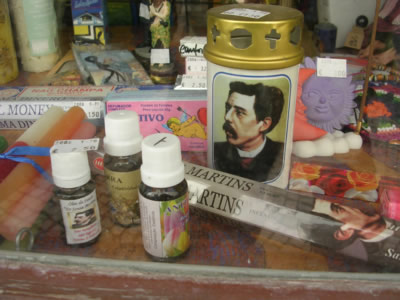
Lisbon dr Sousa Martins wax candles small shops

Candles with dr Sousa Martins’ picture are for sale in lots of small shops in Lisbon.

How to reach this place

From Rossio train-metro Station Lisbon to Pena Palace in Sintra/ Queluz Palace

Rossio train- and metro station (Estação do Rossio) is incredibly unique, located between Rossio and Restauradores in Lisbon.  The beautiful neo-manueline architecture was designed by architect José Luís Monteiro, completed in 1887.

Lisbon Rossio Station at night

Rossio train- and metro station Lisbon

The Neo-Manueline façade dominates the northwest side of the square and is a Romantic recreation of the exuberant Manueline style, typical of early 16th century in Portugal. Its most interesting features are the two intertwined horseshoe portals at the entrance, the watch in a small turret and the abundant sculptural decoration.
Rossio station, Largo do Duque de Cadaval, Lisbon World Cup Football 2010

Near the station you can have a drink at Largo do Duque de Cadaval, which is a really nice square full of open-air cafés.
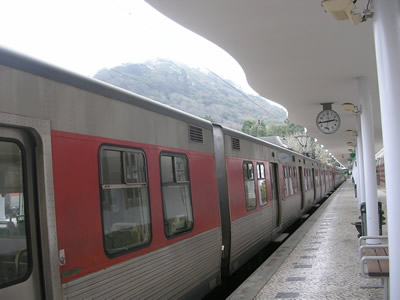
Lisbon Rossio Station inside Train

Rossio train- and metro station Lisbon

Inside the station, the platform is connected by ramps to the façade level and is covered by a cast-iron structure.  The station is an important example of Romantic (façade) and Cast-iron (platform cover) architecture in Portugal.

Lisbon Station Rossio inside

Rossio train- and metro station Lisbon

Downstairs is Rossio’s metro station (green line). Metropolitano de Lisboa, Lisbon Metro official page (also in English), you’ll find a map with a network diagram and explanation of the metro lines.

Lisbon Rossio Station train to Sintra

Rossio train- and metro station Lisbon

Visit Sintra and Queluz, easy to reach by train from Rossio train- and metro station

The wonderful Rossio train- and metro station is a must see if you visit Lisbon.

If you like to visit Sintra, the famous World Heritage town and the Pena National Palace just outside Lisbon or the National Palace in Queluz, you can take the train here for a cheap price.

From Rossio Station to Sintra station

Sintra Station.

Trains to Sintra (and vice versa) leave every 15 minutes, a 45 minute trip. The access of trains to the Rossio station is made by a tunnel more than 2600 m long. This tunnel was escavated under the city and is considered one of the most important works of engineering of Portugal in the XIX century.

From Rossio Station Lisbon to Sintra station

Sintra Station

Besides: if you prefer to go by car to visit Sintra, the IC19 superhighway takes you directly from the city and it comes to an end at Sintra . Parking is possible, 10 minutes walk from the center of Sintra.

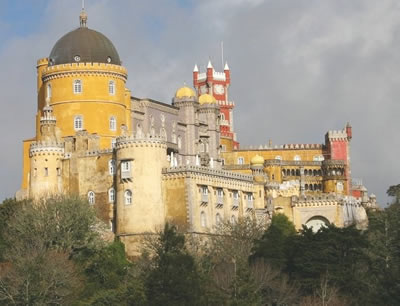
Sintra Palacio da Pena

The Pena National Palace, built by a noble man for his Portuguese wife

A one-day ticket (around 7 Euro) can be bought at Sintra station and will allow you to get on and off at all the main attractions, like f.i. Pena Palace and The Moorish Castle.

Sintra National Pena Palace July 2011. Picture: Maurits Benschop

Historical area Mouraria Lisbon, fado museum & Amália Rodrigues, queen of fado

No neighborhood in Lisbon is praised more for Fado music than Lisbons historical area Mouraria.

Mouraria Calçada de Santo André balcony with flowers

Mouraria, Calçada de Santo André.

This ‘Bairro‘ (neighborhood) is a maze of little, narrow streets, situated between Graça, Alfama and Costa de Castelo, given it’s name by the first Portugese king, Dom Afonso Henriques (1109 – 1185) , after Lisbon was taken over again by the (Christian) Portugese army from the Moorish overlords. The Moors however kept on living in the city after the conquist and gathered in this area.

Portuguese blues

It is said that the melancholic sounds of the music and singing of the Moorish people was at the base of Fado (meaning fate) music, often described as the Portuguese blues. Its passionate songs overflow with saudade ( yearning), with sorrowful themes like despair, loss, betrayal, jealousy and unrequited love. The little streets of Mouraria are full of typical small grocery stores, old bars (some Fado taverns) and cheap traditional restaurants.

Ginja Cafe in area Mouraria

More history of Fado (and the sad story of the legendary fadista Maria Severa (1820 – 1846) on this website.

Stencilled paste-up of Amalia Rodrigues, Beco dos Cortumes August 2007

Picture: Jef Aerosol. Stencilled paste-up of Amalia Rodrigues, Beco dos Cortumes, Alfama, Lisbon

Amália Rodrigues, Rainha do Fado (‘queen of Fado’) was born near Mouraria on Rua Martim Faz in 1920. She was a genius and worldwide famous Fado singer and lived for many years on Rua de Sao Bento 193. Nowadays her house is a museum, it’s just like she’s still living there…  Casa Amalia Rodrigues ; 30 minutes guided tours from Tuesday – Sunday 10:00 – 13:00 and 14:00-18:00. Metro: Rato.

Amália Rodrigues lived near Mouraria, one of her very famous songs: Ai, Mouraria (Oh Mouraria), da velha Rua da Palma (near the old street ‘Rua da Palma’), onde eu um dia (where one day), deixei presa a minha alma (my soul became a prisoner)…

Amalia Rodrigues tomb Panteao Lisbon

On October 6, 1999, Amália Rodrigues died at the age of 79 in her home in Lisbon.

Portugal’s government promptly declared a period of national mourning. She is now buried at the National Pantheon alongside other Portuguese notables.

Amalia Rodrigues shop Rua Aurea 274

‘Discoteca ‘Amalia’ Rua Aurea 274, a shop specialized in traditional Fado music. Very friendly and professional staff.

For those interested in knowing more about fado music style: the Fado Museum  is located in front of Largo do Chafariz de Dentro (the historic Alfama neighborhood) including a permanent exhibition, a temporary exhibition area, a documentation centre, a store, a small auditorium, a school, and a restaurant/coffee-shop. Saturdays and Sundays, 4h30pm guided tour of the museum featuring the participation of fado singers of different generations.

Open from 10:00 am – 18:00 (closed on Mondays)

Metro Station Lisbon area Baixa-Chiado: free escalators & avoid hundreds of stairs

Metro Station Baixa-Chiado is a unique and impressive subway, opened in 1998, created by architect Álvaro Siza Vieira.

Metro Station Baixa Chiado Rua do Crucifixo entrance

Metro station entrance Baixo-Chiado Lisbon, Rua do Crucifixo.

Metro station Baixo-Chiado is one of the most important transfer stations, and one of the most crowded of Lisbon.

Metro Station Baixa Chiado entrance tiles

Metro station Baixo-Chiado Lisbon

Beautiful white tiles are covering the station walls.

This metro station has an entrance in the Baixa city center as well as one at a much higher level in the Chiado district, linked by a series of escalators.

Metro Station Baixa Chiado escalator

Metro station Baixo-Chiado Lisbon

Instead of walking (hundreds of stairs from Baixa to Chiado), an alternative and free way is to use the escalators inside the metro station, reaching the Chiado district ca. 5 minutes later.

Of course, walking is also interesting…..  🙂

Metro Station Baixa Chiado metro lines

Metro station Baixo-Chiado Lisbon

The Lisbon Metro operates from 6h30 to 01.00. Tickets: cheap 🙂

Metropolitano de Lisboa : Lisbon Metro official page.

Metro Linha Azul (blue line) Metro Linha Amarela (yellow line) Metro Linha Verde (green line) and Metro Linha Vermelha (red line).

Also including a special section on subway art of Lisbon Metro stations with stunning examples of contemporary azulejos (Portugues tiles).

Metro Station Baixa Chiado escalators up to Chiado

Metro Station Baixa-Chiado

Escalators up to the Chiado district.

Metro station Largo do Chiado Pessoa

Cafe ‘A Brasileira’, Largo do Chiado, near the entrance of the Chiado metro station.

The bronze sculpture of Portugal’s famous writer and poet Fernando Pessoa (1888-1935),  is extremely popular. More…….

Top tourist attraction Lisbon: bronze sculpture famous poet Pessoa & history

The bronze sculpture in Lisbon of Portugal’s famous writer and poet Fernando Pessoa (1888-1935) is extremely popular.

Lisbon cafe A Brasileira tourist attraction statue Fernando Pessoa

Sculpture of famous poet Fernando Pessoa, kissed by a young girl, almost 80 years after his death!   🙁

Top tourist attraction

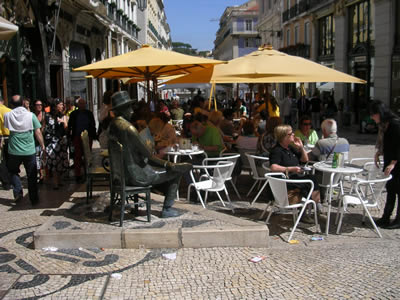
Famous cafe ‘A Brasileira’  ‘s terrace in Lisbon (Rua Garrett 120) is a real tourist attraction. Poet Fernando Pessoa once was a regular customer. His table in bronze was created by Lagoa Henriques.

Pessoa statue Rua Garett A Brasileira9

Famous old cafe ‘A Brasileira’  (‘The Brazilian’, opened in 1905) Lisbon, Rua Garrett

Who was poet and writer Fernando Pessoa?

Pessoa was largely unknown in Portugal until after his death in 1935. The man has no idea he’s mobbed by lots of tourists nowadays, all day long!

Lisbon Pessoa statue Rua Garrett & friend Hans

Sculpture poet Fernando Pessoa Lisbon & Dutch admirer Hans

‘The best way to travel is to feel’ Pessoa wrote, ‘so feel everything in every possible way.’ Pessoa was born in Lisbon in 1888.

Apart from his high school years which he spent with his mother and half brothers in South Africa, he lived in Lisbon without a break, without taking public holidays, without traveling abroad. He did so with the help of heteronyms, inventing many lives (and cities) out of his own, spent between the Chiado area, where he lived.

Restaurant Martinho da Arcada table Pessoa famous Portuguese writer

Quality Restaurant Martinho da Arcade, Lisbon.

Restaurant Martinho da Arcade Lisbon & Pessoa’s table

Portugal’s famous poet and writer Pessoa spent a lot of his time in cafes (like Cafe Martinho da Arcada, where he wrote and drank a lot . He died in 1935, aged 47.

Pessoa’s table is still there…

Fernando Pessoa

Fernando Pessoa

Casa (house) Fernando Pessoa, Rua Coelho da Rocha, 16, Campo de Ourique.

Open from Monday – Saturday 10:00-18:00.

Pessoa drawing Travessa do Sequeiro

Drawing Fernando Pessoa, Travessa do Sequiero Lisbon

“Acordar”, poem by Álvaro de Campos, one of Fernando Pessoa’s various ‘heteronyms’ (imaginary characters).

“Acordar da cidade de Lisboa mais tarde do que as outras
Acordar da Rua do Ouro
Acordar do Rossio, as portas dos cafés
Acordar…..
E no meio de tudo a gare, que nunca dorme
Como um coração que tem que pulsar através de vigilia e do sono”

“The waking up of Lisbon, later than other cities
The waking up of Rua do Ouro
The waking up of Rossio Square, at the doors of its cafes
Waking up…..
And in the middle of it all the train station, which never rests
Like a heart that has to beat in both waking and sleeping hours”

Pessoa drawing Rua 1 Dezembro Lisbon

Rua Primeiro de Dezembro, April 2009

Lisbon & lotteries: Rossio Square & story about jackpot queen Leonor

After buying postcards in Lisbons’ touristical shops or kiosks at Rossio Square, you need stamps (selos) to send them to your friends or family. ‘Very sorry, no stamps’ (‘Desculpa, não selos’).

UPDATE 2016: most shops sell stamps. Update 2021: this shop is closed

Lisbon Rossio square kiosk

Rossio (square Dom Pedro V

This square is a traditional meeting point both for Lisboetas (locals) and visitors.

Lisbon Rossio Portugese man drinking a Ginja

Besides, Rossio near Restauradores:

Portuguese like to drink a ‘Ginjinha’, a liqueur made of berries.

Lisbon Rossio lottery

For stamps friendly Portuguese shopowners will explain you how to walk to a nearby postoffice.

Or they tell you to go to ‘Casa da Sorte’ (a lottery shop), where’s a little postoffice inside, Praça Dom Pedro IV, # 120.

Lisbon Rossio lottery Casa da Sorte

As soon as you’re inside, you forget about the stamps….

Portuguese people love lotteries!

Lisbon shopping stamps Casa da Sorte Rainha Dona Leonora

Queen (rainha) Dona Leonor

In the corner of the lottery shop queen (rainha) Dona Leonor, wife of the 15th century king Dom Manuel I.

She created the ‘Foundação da Misericórdia’ (Foundation for Charity) that is still very active in Portugal today. The original purpose of the Foundation was to build and manage hospitals and homes for the old and needy. Today, the Foundation has spread its wings in obtaining funds and they run all forms of Lotteries in Portugal.

Lisbon lottery

Dom Pedro IV Square, or Rossio (big square), in the evening, one of the most beautiful Squares in Lisbon.

Lisbon Rossio

Historical information Rossio:    http://en.wikipedia.org/wiki/Rossio